ACT-GenAI: Advancing Creative Thinking, Physics Learning, and AI Literacy through Little c, a Generative AI Coach in a Sandbox Learning Environment
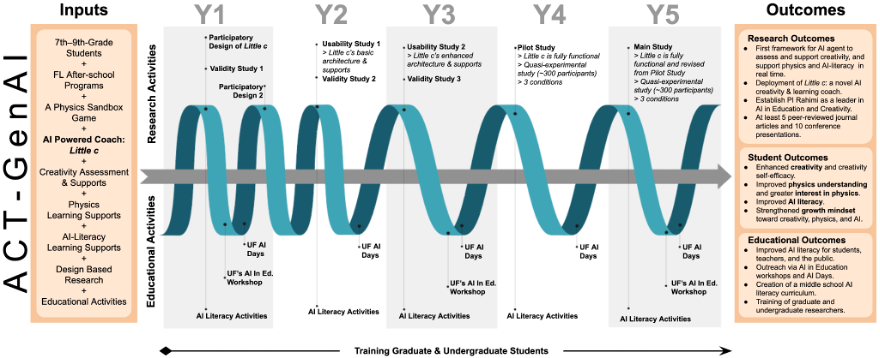
ACT-GenAI integrates two core components: (1) a research strand focused on developing and validating Little c to advance student and research outcomes; and (2) an educational strand that engages diverse stakeholders through interactive activities to broaden projects’ impact beyond the immediate research context. This project supports students’ figural (visual) and verbal (language-based) creativity as students design physics-based game levels—skills that are both measurable and transferable to broader STEM contexts.
Project Description
What is Little c
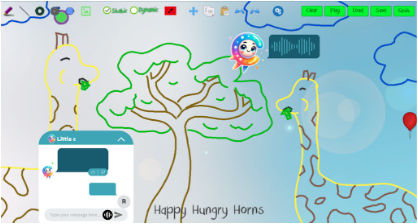
Little c is an AI-powered coach in a sandbox learning environment where students create, test, and revise physics-based designs.
Little c will access students’ creative work and provide personalized support for generating ideas, improving designs, learning physics, and developing AI literacy. Working with students students and teachers, this research will investigate how AI can support learning while keeping students engaged in the cognitive work that matters.
Research Questions
- (Y1):How should an AI-powered agent (Little c) be designed to assess creativity and provide targeted supports for creativity, physics literacy, and AI literacy in a sandbox game?
- (Y1、Y2、Y3):To what extent can GPT-4o (or an improved version; e.g., GPT-5 which is going to be released in summer 2025), enhanced by retrieval-augmented generation (RAG) and fine-tuning, produce valid estimates of creativity?
- (Y2、Y3):To what extent do students find the prototype of Little c useful and usable during level creation? What are their suggestions for improvement?
- (Y4、Y5):What are the effects of Little c (with creativity assessment and tailored supports) on students’ creativity, creativity self-efficacy, interest in physics, physics learning, and AI literacy?
- (Y4、Y5):How do students interact with Little c, and which types of interactions (e.g., asking for ideas, viewing examples, receiving feedback) lead to improvements in creativity, physics learning, and AI literacy?
Project Details
- Lead: Dr. Seyedahmad Rahimi
- Sponsor: NSF CAREER Award
- Funding: $1,665,900
- Duration: 2026-2031
Project Timeline